
Fractured
A sub-publication of Fracture Theory


Fracture Theory concerns itself with the macro: the structural pressures bearing down on society at scale, the mechanisms by which they compound, and the narrowing window in which something can still be done about them. Fractured concerns itself with the micro. Specifically, with one fractured element of a fracturing society. That element is me.
This is not a sob story. It is an examination — held to the same standard as everything else published here — of how an individual fracture transpires, what produces it, and how it flows back into the society that produced it in the first place. The society fractures the individual. The individual’s fracture is evidence of the society’s condition. They are not parallel stories. They are a single recursive loop, readable from either end.
Fracture Theory looks at the world. Fractured looks at one person inside it. The burdens are not identical but if we can find and map out the patterns that create trauma, fracture and break, then we may be able to come up with a formula to mend something greater: the fabric of our modern civilization. The voice in the Fractured segments will be different from that of the theorist in Fracture Theory 101 and 102. The rigor and its application are not.
Fractured 1
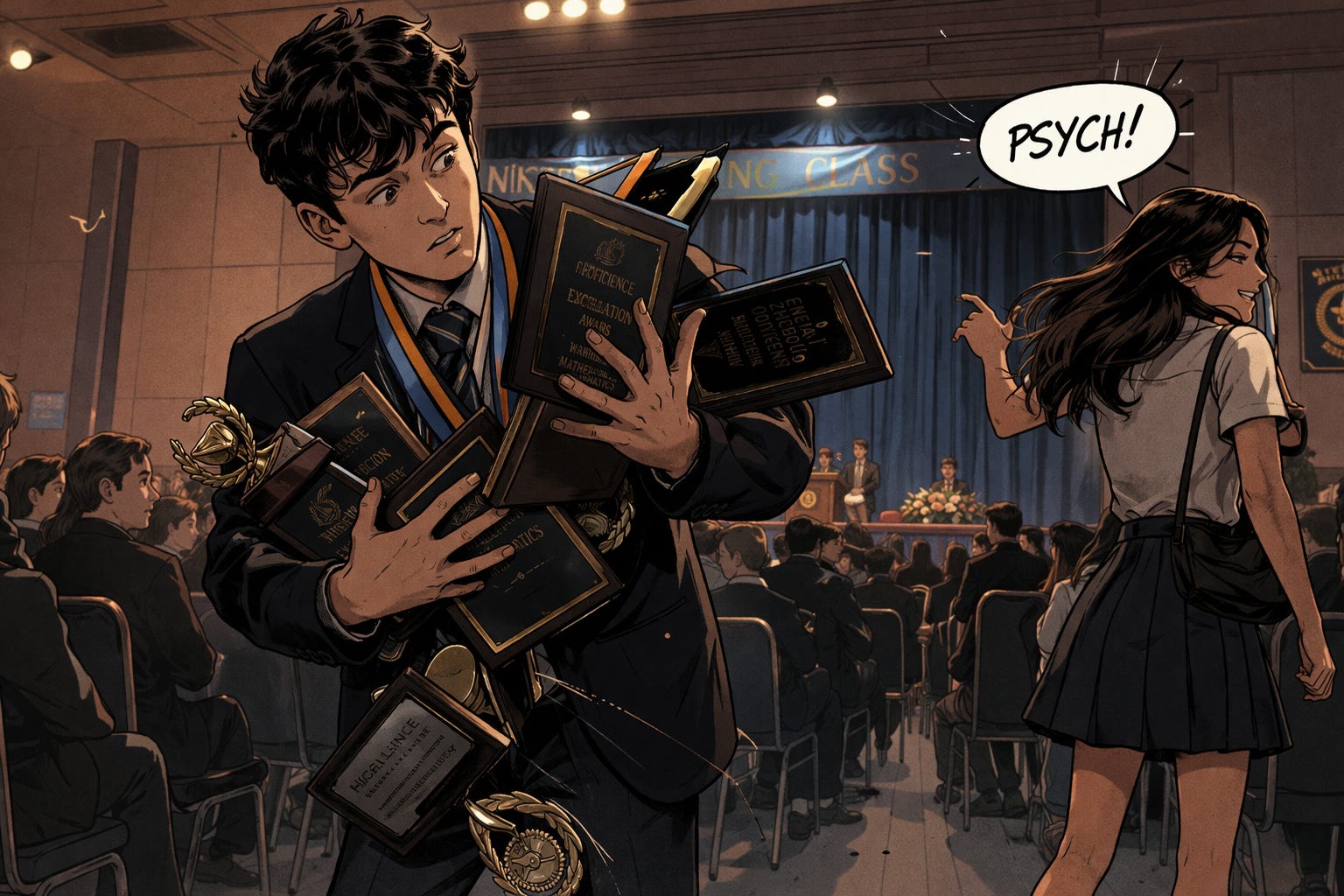
I was fifteen years old and I had nearly swept the board. Four or five awards for highest mark in a class. The general proficiency award. The excellence in education award. Two awards that overlapped in what they were recognizing, which says something about how institutions praise and nothing at all about what any of it felt like to carry. I was also one of two valedictorians who co-wrote the speech with an amicable classmate, though how fond I was of those years I would not know until long after. I got the school letter. I got the award for president of the boys’ athletic association. By the end of the ceremony I was holding more than I could physically manage, which is the kind of detail that would read as metaphor if it were not also literally true.
Someone offered to help me carry them. I was relieved. I said yes. She said “Psych” and walked away.
I have thought about that moment more times than I can count. Not because it was the worst thing that ever happened to me — it was not, not even close — but because of the specific cruelty of its timing. The moment I should have felt most certain of my own value was the moment chosen to remind me that value, as far as the social world was concerned, was not mine to claim. At fifteen, I did not have the language for what that did. I only knew that something shifted, and that the shift stayed.
What I could not see at fifteen, and what took considerably longer to understand, is that the collision was not one-directional. Fracture Theory calls this the particle model: we are all systems in motion, and every collision alters a trajectory. Hers included. I had obliterated her academically — completely, without trying, which may have been the more humiliating part. If she had any aspirations of being the best at something in that room, I had already closed that door before the ceremony began. Jealousy burns at any age. At fifteen it burns without context, without the language to name it, without anywhere useful to put it. She was a particle in motion too. We collided. Both our trajectories changed. I don’t hate her for it anymore.
What followed was not a clean collapse. It was something slower and in many ways more corrosive: a decades-long pattern of approach and withdrawal, of getting close to the thing I was capable of and then finding a reason — or having a reason find me — to step back from it. I dropped out of high school. Went back. Dropped out again. Finished. The marks were always there when I showed up. I was not less intelligent in the years I disappeared. I was less able to tolerate the distance between what I knew I could do and what I was being asked to endure to do it. Either I got the marks or I got nothing, because that was the only register I understood: full presence or full absence, with very little survivable territory between them.
I dropped out of university twice. College once. I slept through most of my twenties. Not homeless, not adrift in the conventional sense: I was in the house I had lived in since I was eleven, my parents’ house, which I still live in and make no apology for. But I was largely horizontal. In bed, on the couch, absent from the day in the way that depression makes a person absent: present enough to breathe, gone enough that it barely counted. I went to work some days and did not go other days. I put holes in walls. I was hospitalized. In 2002 I swallowed fifty Tylenol, not to die, I told the psychiatrist, just a cry for something I did not have words for. He looked at me and said: you swallowed fifty Tylenol. Whatever you intended, the judgment that got you here was not sound. He was right. I got lucky in a way I did not fully appreciate until much later, when I understood what Tylenol does to a liver and what an allergic reaction to the antidote actually means. I could have died. I could have survived with permanent liver damage. There was a version of that night that ended very differently, and the only thing standing between me and it was chance. I stayed about a week in what the patients called Hotel 6, the H wing of East General, inpatient psychiatry, free of charge, which was the joke we told ourselves to make it feel like a choice. It was not a choice. It was where I needed to be.
I want to be precise about accountability here, because precision is what this publication requires and because imprecision on this particular point does real damage. I am not asking for absolution. I am fully accountable for every hole in every wall, for every institution I walked away from, for every person I exhausted with the weight of what I was carrying. Accountability is not the same as blame. Blame assigns fault to an origin. Accountability says: regardless of origin, the consequences are yours to bear and, where possible, to repair. I bear mine. I have been bearing them since 1989.
I was eight years old and I remember it as suffering. Not confusion, not vague childhood anxiety, but mental anguish of the worst and most private kind. The obsessions came without invitation and without mercy. Someone would brush past me in a hallway and I would spend time inside the question of whether I had somehow hurt them. Not physically, not obviously. Just: did something I do alter the course of something for someone in a way I could not undo. Fictional hurts. Imagined transgressions against people who had no idea any of it was happening. Minutes sometimes. Hours. Days. Weeks. Some of them, when I became an adult, lasted years. It depended on the nature of the obsession, on where it hit me and how deep it went. And when one finally burned out, the floodgates opened and another took its place in a fraction of a second. The moment release set in, something else was already waiting. I knew it was torture. What I did not know was why. I did not know if it was my fault. I did not know if I had done something to deserve it or if it had simply arrived, uninvited, and decided to stay. What is a child supposed to do with that?
I would not have the language for what it was until I was twice the age I had been when it started. And by the time I did, by the time the words finally came for what had been living in me since I was eight years old, that was the same year the first real crisis came. Understanding and collapse arrived together. That is not a coincidence. That is what happens when you stop burying something long enough to finally see it.
But here is what Fracture Theory requires me to also say: the origin matters. Not as an excuse. As an explanation. As the mechanism. A person is the product of their accumulated experience plus the pressures of the environment they currently occupy. That is the behavioral premise that runs through everything published in this series. If it is true at the scale of societies — and the evidence says it is — then it is true at the scale of a single person sitting in a high school auditorium, holding more awards than he can carry, being told by the social world around him that his achievement is something to mock.
I was not born intelligent. That is worth saying plainly because the mythology of natural gifts is one of the most destructive fictions a society tells itself, and it did real damage to how I understood what happened to me. In the very beginning of grade three, I was placed in a remedial class. I came home and told my mother they had put me somewhere I did not belong. She listened. She found a professor, Michael Vitopoulos, who taught Greek studies at York University, a man with dark hair and a thick black mustache and the kind of certainty about people that you don’t forget. He tested my aptitude and told my parents there was nothing wrong with my intelligence. He then introduced us to his wife Natasha, a school teacher, who became my tutor. In a few months I was the top student in my class. Michael believed in his wife’s work and he believed in me. Two decades later, when I was already lost and working as a sales clerk in my parents’ Greek music store, he told me I would one day write something great. I never tried to prove him right in all the years between then and now. I was too lost in the world and in my own mind, spending myself on things that didn’t matter. I am trying now. Not for money or fame. I can be poor and be discovered years after I am gone. What matters is the work, not the worship.
Twice a week for at least a year, my mother drove me to tutoring in a Volkswagen Jetta. She would quiz me on my multiplication tables, and in the gaps between questions, a cassette tape played. The Beatles were part of the furniture of my childhood, along with Star Trek and a love of science fiction. She ran away from home to go to university in Windsor and paid for tuition by working the whole time. Rebelling for the sake of education is the kind several generations become proud of. She majored in English literature and minored in psychology. Both are ironic because I became the writer, an individual who has dropped out of plenty of institutions, and she had no way of knowing back then, even with a minor in late 1960s abnormal psychology, what would eventually hit home. In 1989, very few would have picked up that thread.
A mother, a car, a multiplication table, a song. The behavioral premise in its smallest and most human form: the right conditions, applied consistently, by someone who refused to accept the institution’s verdict. That is what produced the boy who stood in the auditorium seven years later with more awards than he could carry.

The question I ask myself — and I ask it often, on the mornings when the distance between that auditorium and where I am now feels like a verdict — is how the others ended up in suits, with titles and houses and the external markers of a life that compounded forward, while I ended up here. Thirty years of approach and withdrawal. Of knowing exactly what I am capable of and being unable to sustain the conditions under which that capability survives.
The answer to that question is what pulls me out of the hole. Not out of curiosity, not as an academic exercise, but because the answer is the only thing that makes the next morning worth attempting. If the fracture was produced by identifiable conditions, then it can, in principle, be addressed by changing them. Not undone. A fracture that heals is still a bone that was fractured. But held. Functional. Capable of bearing weight again.
I once told someone who wanted to die that the only failure in life is suicide. I meant it then and I mean it now, not as a moral judgment against those who did not survive their worst night — they are not to be blamed, only mourned — but as the clearest possible statement of what I believe about what it means to be alive. If you are alive, you can still change almost anything. You can fail and then succeed. You can lose everything and build something from what remains. Accountability and possibility are both made yours in the same breath, as the two are inseparable.
I am still here. That is not nothing. On the mornings when it feels like nothing, I return to a car, a mother, a multiplication table, the music and the knowledge that the things that burnt me like a simple “psych” in an auditorium and built me like in that car, are all part of the same fabric. I can use them to navigate the world now that I understand them. I can also do what Michael believed all along. I can, I will, I am, writing something great.
If this piece brought you here for the first time, welcome. The framework it draws from lives in Fracture Theory 101 and Fracture Theory 102. That's where the wider argument begins.
Have You asked yourself what does it mean for you to identify yourself with that experience when you were teenager?